Most people pick a CRM based on brand recognition or feature lists.
Someone says HubSpot is the industry standard. Someone else says Salesforce is what serious companies use. A founder wants something modern. A sales lead wants something easy. A decision gets made.
This is how most CRM problems start.
There are over 2,000 CRMs on the market. That’s not a sign that the space is innovative. It’s a sign that there is no single “correct” way to run a business. Different CRMs are built around different assumptions about how work actually happens.
If you don’t understand those assumptions, you’re not choosing a CRM. You’re inheriting one.
Why Feature Comparisons Miss the Point
On paper, most CRMs look interchangeable.
They all store contacts. They all have deals. They all automate emails. They all generate reports.
What actually differs is what happens once real life starts:
- In some CRMs, the deal is the centre of everything. Everything else exists to support closing it.
- In others, the company is central, and deals are just events that happen over time.
- Some CRMs assume one rep, one deal, one pipeline.
- Others assume long-lived relationships with multiple people, products, and owners.
- Some let you add new entities easily – products, locations, subscriptions.
- Others start fighting you the moment you step outside the default flow.
- Some feel great with one team and ten deals, then become unmanageable when a second team or motion appears.
These differences are not configuration details. They are baked into how the CRM is designed.
That design is what you’re actually choosing.
Modern Object-Based CRMs
Twenty CRM and Attio
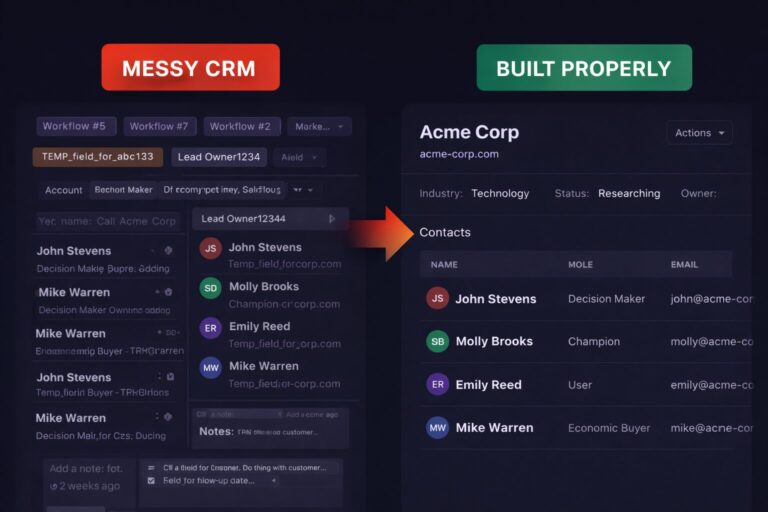
These CRMs are built around one idea: model the business first, then layer workflows on top.
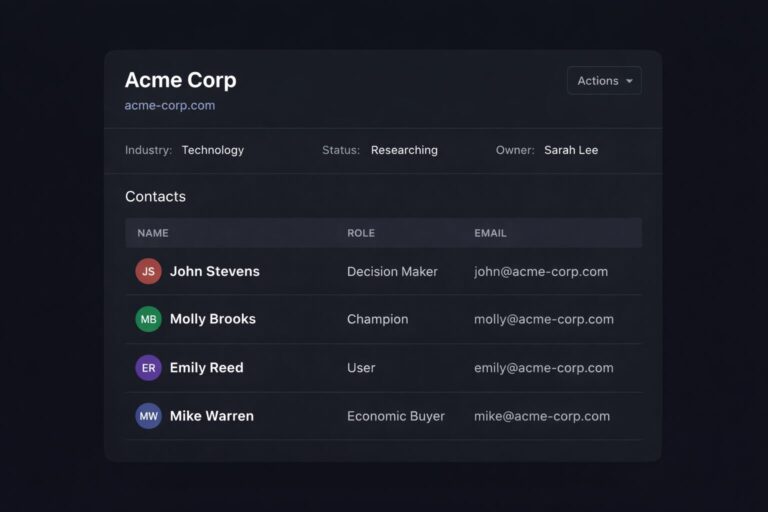
You’re not forced into a single pipeline. You define what exists – companies, people, products, subscriptions, locations – and how those things relate.
Pipelines become just one view of the data, not the backbone of the system.
This works well when:
- Your business doesn’t fit neatly into one sales pipeline
- Multiple teams touch the same accounts
- Relationships last longer than a single deal
- You expect your structure to evolve over time
- You want the CRM to reflect reality, not shape it
This becomes painful when:
- You want the CRM to tell you how to sell
- You don’t want to make structural decisions
- You expect “best practices” to be enforced automatically
Attio is polished and opinionated. It gives you object flexibility without feeling enterprise-heavy.
Twenty goes further. It’s open source, extremely customisable, and cheap per seat. You can model almost anything if you’re willing to design it.
We’re personally bullish on Twenty long-term. It’s hard to imagine a future where a highly flexible, open-source, object-based CRM doesn’t become a major player. The trade-off is obvious: it requires real setup and ongoing development. That’s not a downside if you know what you’re building – it’s the point.
Relationship and Enrichment CRM
Folk
Folk is easiest to understand by how teams actually use it.
Teams use Folk to:
- keep track of who they’ve spoken to
- automatically enrich contacts from email, calendar, and LinkedIn
- see shared history across conversations
- avoid losing context when people leave
It’s common in partnerships, recruiting, agencies, founder-led sales, and network-driven teams.
What Folk does not try to do:
- run complex workflows
- enforce strict process
- act as a system of record
- model deep operational logic
If you try to run sales operations or multi-team processes in Folk, you’ll hit limits quickly. Used alongside another system, it can be extremely effective.
Pipeline-First CRM
HubSpot
HubSpot is built around a simple assumption: work progresses through deals in pipelines.
Contacts feed deals. Deals move through stages. Automation reacts to stage changes. Reporting rolls up around pipelines.
Where HubSpot shines:
- Fast adoption
- Standard sales motions
- Strong marketing and sales alignment
- Minimal upfront design
Where it starts to break:
- Your core entity is not a deal
- You need complex relationships between entities
- Multiple teams share account ownership
- You start bending pipelines to represent non-pipeline work
HubSpot has added custom objects, but it is still fundamentally pipeline-driven. Many companies eventually outgrow it for this reason.
Enterprise Object Platform
Salesforce
Salesforce assumes complexity is inevitable.
In practice, this means:
- multiple teams using the same CRM
- strict permissions and ownership rules
- audit trails and compliance needs
- multiple sales motions running in parallel
Salesforce gives you raw power. It also requires responsibility.
Salesforce works best when:
- The CRM is core infrastructure
- Many teams depend on it daily
- Someone is accountable for architecture and governance
- Ecosystem depth and acquisition compatibility matter
Without clear ownership, Salesforce doesn’t fail fast. It slowly turns into an expensive mess.
Flexible but Underrated Platform
Zoho CRM
Zoho is often dismissed because it lacks polish and prestige.
Under the hood, it offers deep configuration, custom workflows, and object-like modelling at a much lower cost than Salesforce.
Zoho works best when:
- You’re willing to design your setup intentionally
- Cost matters at scale
- Flexibility matters more than aesthetics
It struggles when teams expect the CRM to organise itself.
In the right hands, Zoho can be extremely powerful.
Where Most Teams Go Wrong
Most teams don’t consciously choose a CRM philosophy. They choose momentum.
Someone picks a tool early. The business changes. The CRM doesn’t. Workarounds appear. Shortcuts harden into structure.
The failure isn’t choosing the “wrong” CRM. It’s choosing a CRM without understanding how it expects the business to behave.
Need Help Picking the Right CRM?
If you’re unsure which CRM philosophy fits your business – or whether your current setup still makes sense – this is usually easier to resolve with an external view.
We help teams map how their business actually works, identify where their CRM will break, and choose a system that fits both today and what’s coming next.
If you want a grounded, pragmatic recommendation rather than a brand-driven answer, get in touch and we’ll walk through it together.